THE BUILDER
Nothing here is decided by a dice roll.
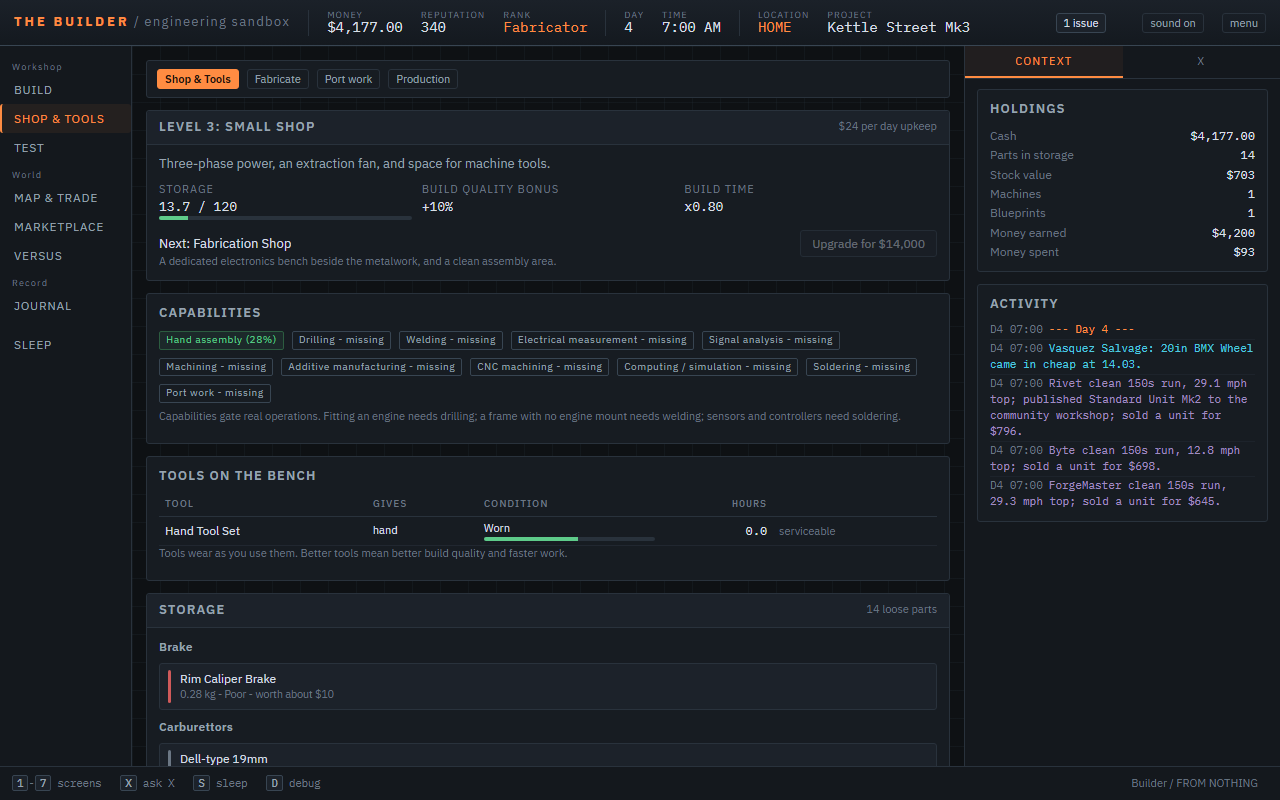
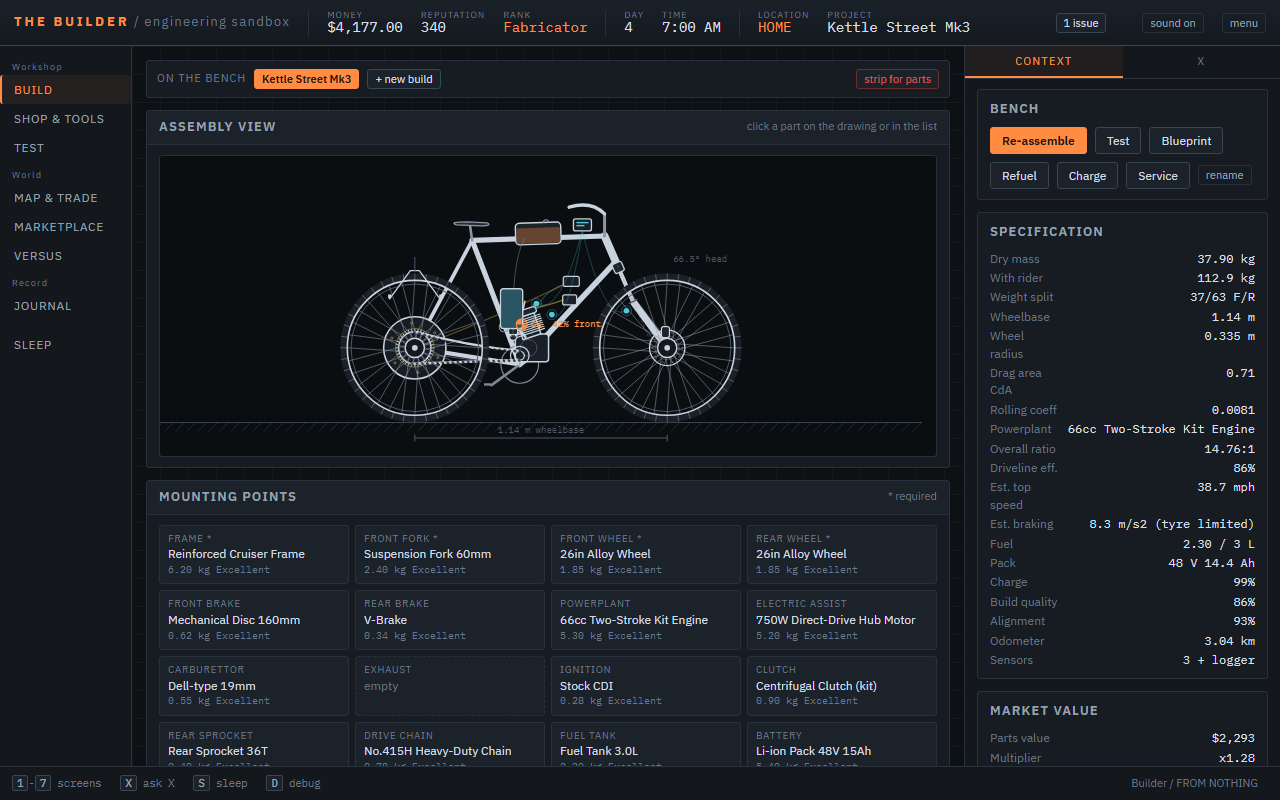
You start with $70, a pile of scrap, one worn spanner set, and rent due. No tutorial, no quest marker, no upgrade tree. There is a workbench, a catalogue of 81 real parts, and a physics engine that does not care what you intended.
Build something. Find out what you built.
A machine is not a template — it is whatever you actually bolt together. Every part carries real attributes and the simulation reads all of them: a Gaussian torque curve keyed to the engine's powerband, a centrifugal clutch whose capacity rises with the square of the revs, chain tension from engine torque over drive-sprocket radius, weight transfer between the axles, per-axle traction limits, convective cooling that scales with road speed and fin area.
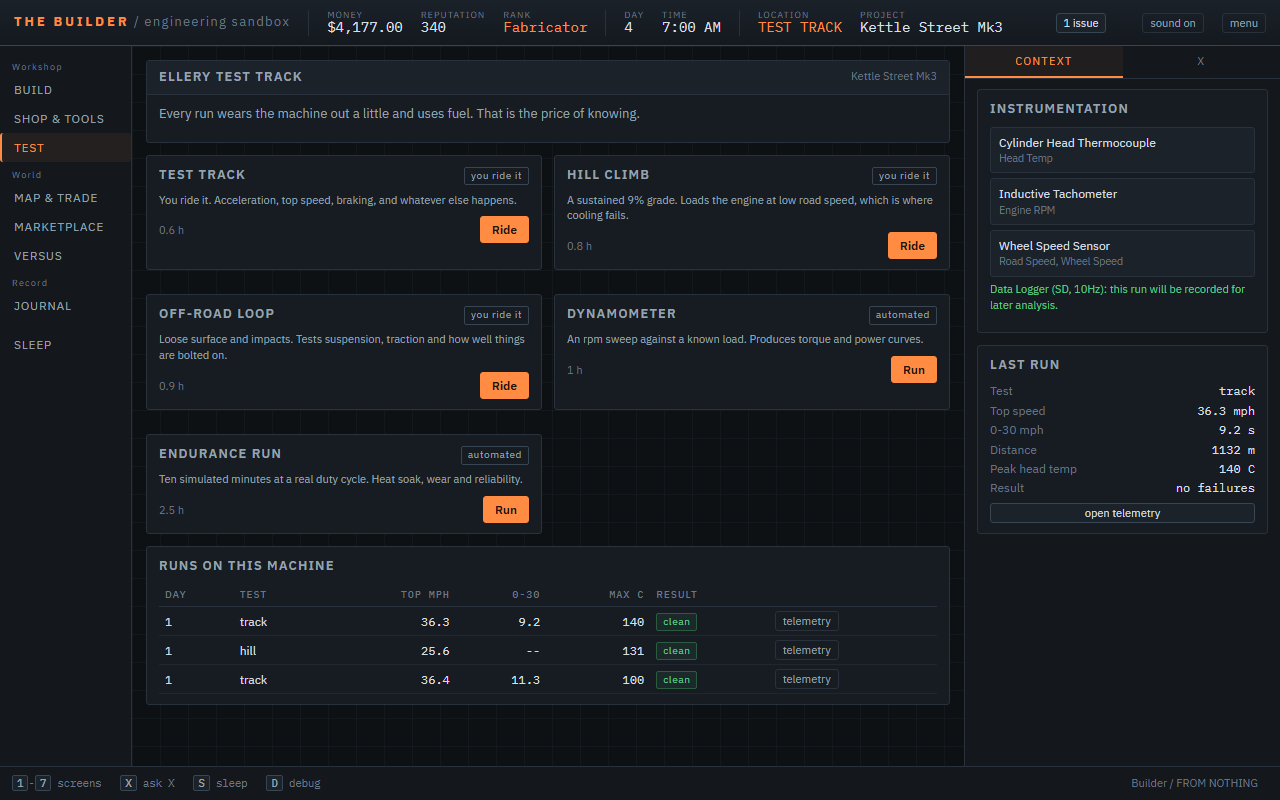
Then you ride it, and the telemetry tells you what happened.
Petrol, electric, legs, or all three at once
Fit an engine. Or a hub motor, a battery and a controller. Or fit both and pedal as well — three sources of drive on one rear wheel, adding up where they meet.
Nobody scripted what happens next:
| 0–15 mph | 16% grade | flat out | |
|---|---|---|---|
| petrol | 5.26 s | 8.9 mph | 30.7 mph |
| electric | 5.49 s | 4.5 mph | 23.9 mph |
| all three | 3.46 s | 24.3 mph | 30.7 mph |
The hybrid is nearly twice as quick off the line and climbs a grade that stops both of its halves — and it is not faster flat out, because a direct-drive hub runs out of revs and is then five kilos of unsprung mass in the back wheel. That is the trade. No line of code states it; it falls out of the model.
It breaks for a reason, and the reason is findable
Nothing fails at random. A seizure has a cause sitting in the data: mixture, cooling margin, time at low airflow under load, over-rev, peak chain tension against the chain's rating. You read the trace, you name the cause, and a wrong answer costs you half an hour and tells you only that the evidence does not support it.
Without a data logger fitted there is no recorded history — only the symptom and whatever you noticed at the time. Instrumentation is a purchase with consequences.
Then the business
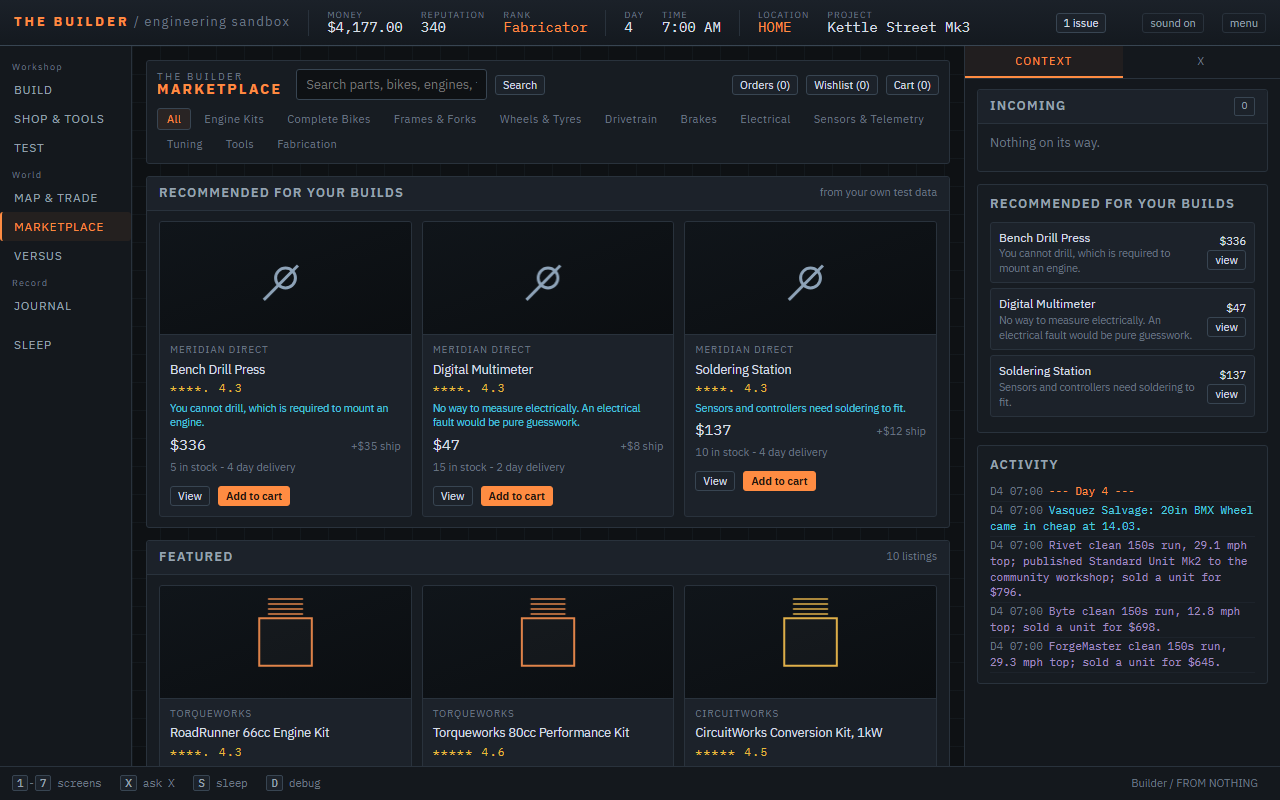
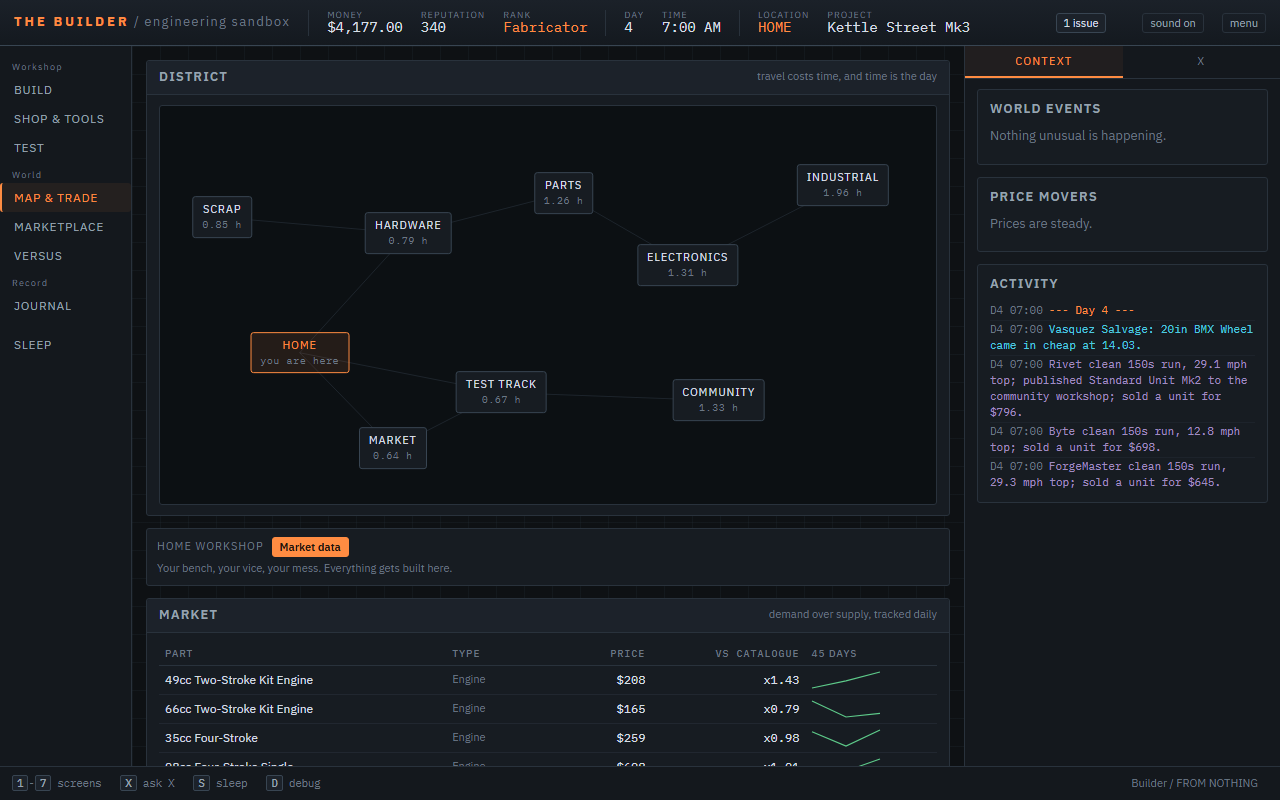
Buy from local counters, where stock is used, random and cheap, or online, where everything is always available, dearer, and arrives on a lorry. Take contracts that state what a machine must do and let you work out how. Make parts at the bench instead of buying them. Tool up a production line. Record a design as a blueprint, evolve it to a Mk4, and licence it to somebody else's workshop. Hire the builders who used to beat you.
Discoveries are earned, not unlocked
Change five things at once and you learn nothing. Change one, run it again, and the game records the relationship along with the two numbers that demonstrated it. That is the whole progression system.
Runs in the browser. Saves locally. No account, no ads, nothing to buy.
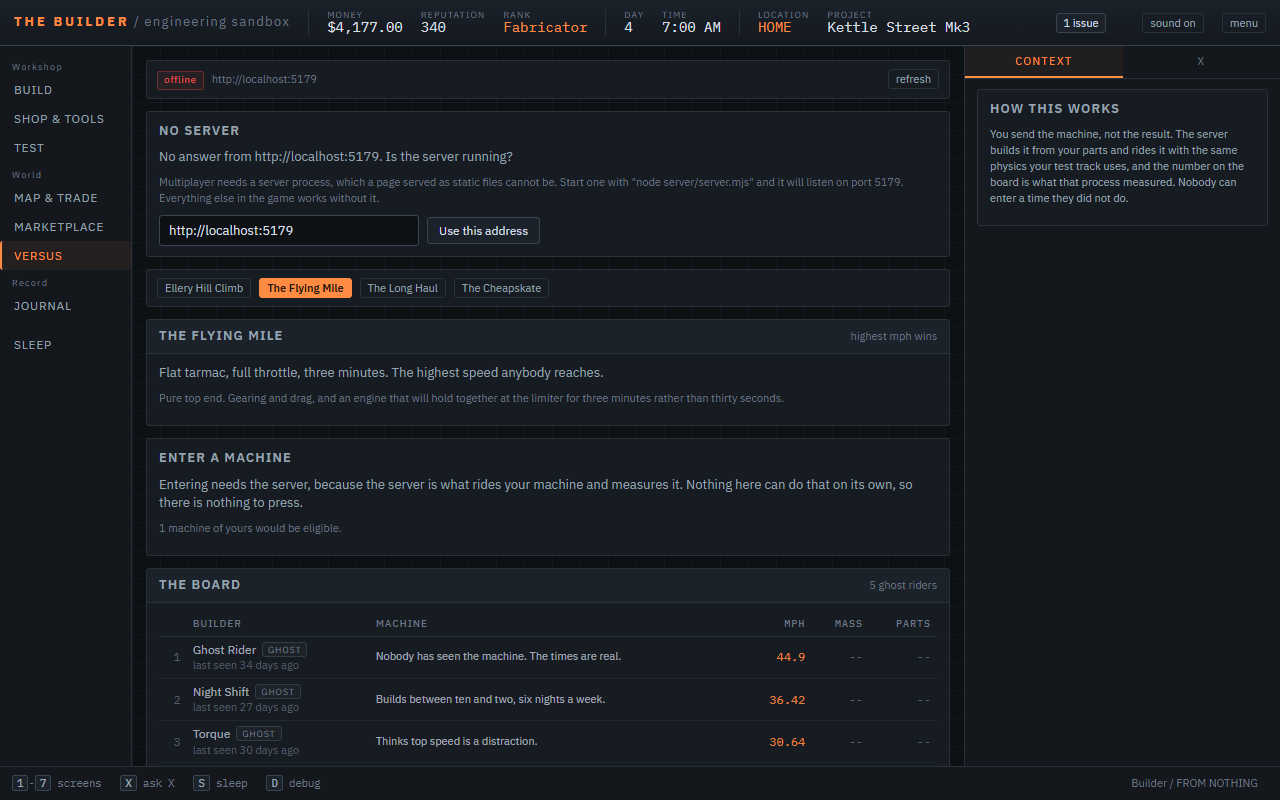
The Versus leaderboard has five ghost riders on it — machines the game measures on your own hardware, labelled as such, there to be chased. Head-to-head against other people needs a server process, which a static page cannot be, so that part says so plainly rather than pretending.
Leave a comment
Log in with itch.io to leave a comment.